

Crisis Management in Arctic Communities: Principles of Crisis Response
Slysavarnafélagið Landsbjörg / ICE-SAR, the Icelandic association for search, rescue & injury prevention. Photo: Ilan Kelman
The Arctic Institute Polar Disaster Series 2026
Despite significant efforts, our capacity to adapt to or mitigate crises in remote regions, such as the Arctic, remains limited. Here, we see how long distances, harsh-for-humans weather, and scarce resources quickly escalate manageable events into full-scale disasters, demonstrating the need for improved crisis management. Climate change and recent geopolitical shifts have intensified vulnerabilities, changing the frequency and severity of both natural and human-made threats.1)Romero R & Emanuel K (2017). Climate change and hurricane-like extratropical cyclones: Projections for North Atlantic polar lows and medicanes based on CMIP5 models. Journal of Climate, 30(1), pp. 279–299; Zahn M & von Storch H (2010) Decreased frequency of North Atlantic polar lows associated with future climate warming. Nature, 467, pp. 309–312; Østhagen A (2017) Utilizing Local Capacities in the Arctic, The Arctic Institute, 14 May, https://www.thearcticinstitute.org/utilising-local-capacities-arctic/. Accessed 1 January 2026
Traditional crisis management treats crises as linear processes that can be broken down and managed in parts. This approach assumes that failures to do so stem from an inability to grasp complexity and lapses in leadership.2)Alexander D (2003) Principles of Emergency Planning and Management (1st ed.). Oxford University Press Some scholars advocate for more decentralised models that involve local organisations in disaster response.3)Andreassen N et al. (2019) Organizing emergency response in the European Arctic: A comparative study of Norway, Russia, Iceland and Greenland (Issue 46) https://nva.sikt.no/registration/0198cc4e7c55-16120a17-4cd6-4808-9bf3-ea22d63a954b; Pescaroli G et al. (2023) Managing systemic risk in emergency management, organizational resilience and climate change adaptation. Disaster Prevention and Management: An International Journal, 32(1), pp. 234–251 However, this can lead to fragmented efforts and a lack of strategic oversight. Incremental improvements may not be enough, especially if lessons are forgotten and resources are diverted elsewhere. The belief that resilience alone can protect or mitigate threats from communities is deeply embedded in current systems, influencing how responsibilities are assigned and responses coordinated.
Response times to Arctic disasters are often slow and cumbersome, and organising effective responses is challenging. The subsidiarity principle—delegating decisions to the lowest practical level—means that individuals on the ground frequently bear the burden of crisis response. While this can sometimes be effective, it risks removing strategic oversight during complex events. A more flexible, network-based model may be better suited to such conditions.
This chapter explores how crisis management structures can be conceptualised for responses in remote Arctic communities. The goal is to propose a conceptual alternative to traditional command-and-control models, which have been the prevailing approach in the region. The chapter begins by reviewing four approaches: functional, resilience-based, adaptive, and self-organising. It then outlines the methodology used to study case examples from Greenland and Svalbard. The final section discusses the implications of adopting a decentralised model for crisis management in remote regions.
Crisis Management Systems
Crisis management involves the capacity to demonstrate cooperation, coordination, the distribution of responsibilities and organising the community.4)Mcconnell A & Drennan L (2006) Mission Impossible ? Planning and Preparing for Crisis. Journal of Contingencies & Crisis Management, 14(2), pp. 59–71; Moon J et al. (2020) Cognition in crisis management teams: an integrative analysis of definitions. Ergonomics, 63(10), pp. 1240–1256
Cooperation is the ability to work with internal and external stakeholders before, during, and after an event.5)Haigh R et al. (2018) A capacity analysis framework for multi-hazard early warning in coastal communities. Procedia Engineering, 212 (2017), pp. 1139–1146; Høgevold et al. (2020) Continuity, coordination and cooperation as mediators between economic and non-economic satisfaction – A sales perspective. Journal of Business Economics and Management, 21(6), pp. 1752–1773 The ability to cooperate reflects the willingness of relational agents to work together when conditions require better use of resources and effective identification of possible common threats. Cooperation occurs through formal and informal ties, which the socio-technical system can utilise to enhance its ability to identify emerging trends and thereby take steps to mitigate consequences as the crisis evolves.
Coordination provides unity of action to pursue common goals.6)Andreassen N et al. (2020) Information sharing and emergency response coordination. Safety Science, 130 (November 2019); Roud E & Gausdal A H (2019) Trust and emergency management: Experiences from the Arctic Sea region. Journal of Trust Research, 9(2), pp. 203–225 It is the added information processing and activity accomplished when multiple related parties pursue objectives that a single agent pursuing the same purpose would not achieve.
Responsibility is the capacity to assign agency to specific tasks that the community needs to perform to manage a crisis.7)Pahlke J et al. (2015) Responsibility effects in decision making under risk. Journal of Risk and Uncertainty, 51(2), pp. 125–146 Formal roles include managerial positions, leadership positions in volunteer organisations, incident command, or being an elected official. Informal obligations arise from expectations that a specific person will assume a leadership role or that members will offer guidance and advice to individuals within their network. A socio-technical system with clearly defined areas of responsibility is seen as having an improved ability to react to disturbances and, thereby, the ability to manage a crisis.
Organising is centred on the ability of the community to establish a hierarchy based on roles, competencies, and capabilities.8)Vogus T J et al. (2014) The affective foundations of high-reliability organizing. Journal of Organizational Behavior, 35(1), pp. 592–596 There are formal and informal forms of organising, which the system can enact in case of an event.
A Community Crisis Management Approach
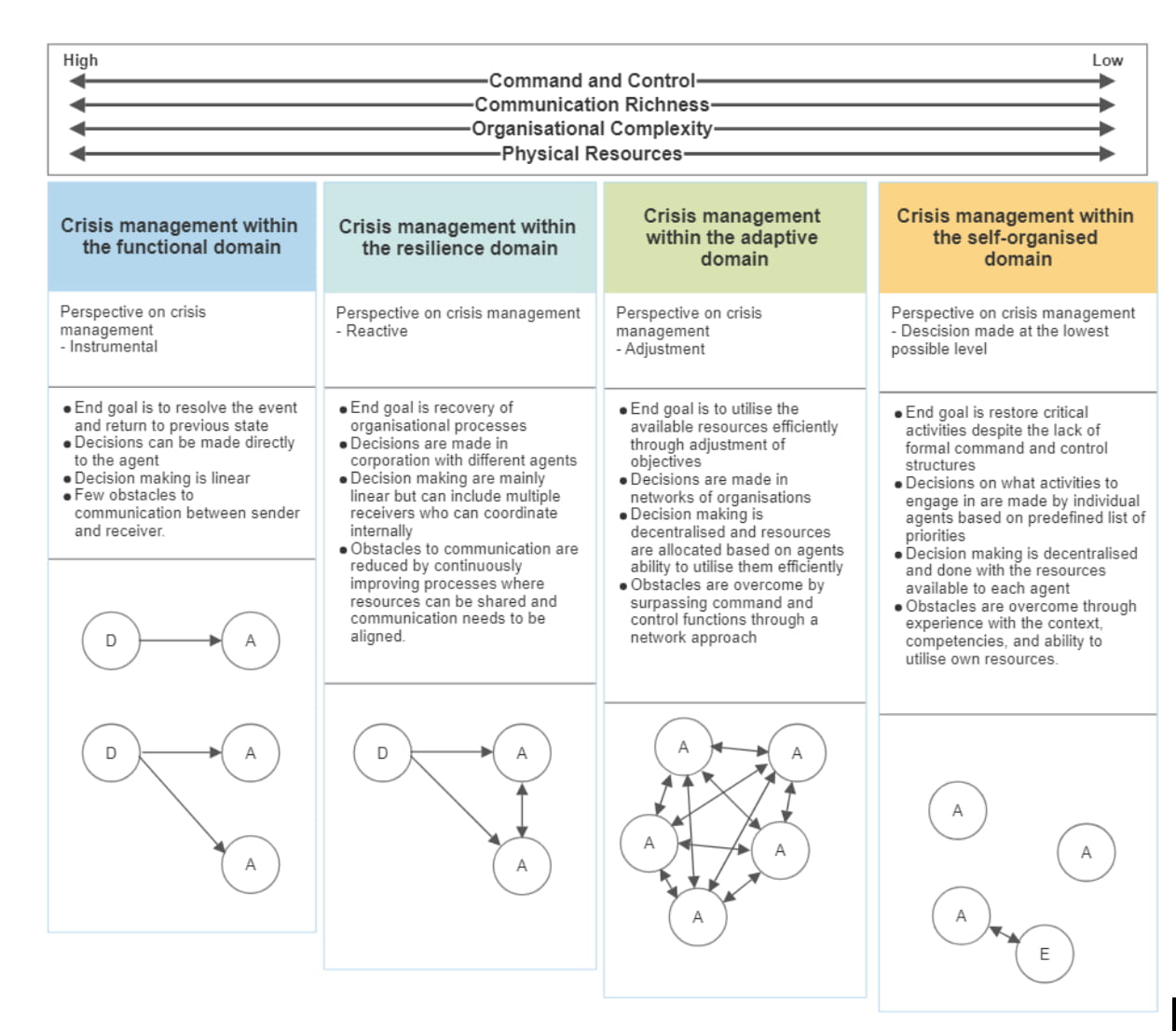
It is possible to place crisis management within four domains (Figure 1). The proposed model describes how decision-makers scale their response to a given event based on the goals the socio-technical system is pursuing and its capacity to demonstrate cooperation, coordination, organisation, and the distribution of responsibilities. It is hence argued that a continuum exists between command and control (cooperation), communication channels (coordination), organisational structures (organising), and allocation of resources (responsibility), depending on the capacity of a central entity to assert control. Hence, a system can be applied to crises where command and control are clear, communication channels are multiple and open, organisation structures are transparent to everyone, and the allocation of resources is done to maximise efficiency.
Method
The research was conducted as a multi-case study using a deductive approach based on individual cases to illustrate the four domains of crisis management (see Figure above) using case examples from the Arctic (Greenland and Svalbard). These two contexts are ideal as they illustrate how all four elements of the crisis management framework are enacted under similar conditions exposed to remoteness, limited resources, and the Arctic climate. Emergency response organisations in Greenland and Svalbard are also isolated, which encourages them to enact crisis management at the local level faster than if an event occurred in a context with more resources, infrastructure, and communication channels.
The case studies include information on the preparedness level in Avannaata and Qeqqata municipalities, Longyearbyen on Svalbard, infrastructure, and the current emergency level. Open source information about national preparedness has been collected from the Greenlandic and Norwegian police, fire departments, municipalities, and national preparedness organisations. Onsite visits confirmed the location of the infrastructure and emergency response capacity, which could not be identified using maps or other remote sensing information. The visits also enabled the collection of more rich information on individual cases. The data collection follows the ethical guidelines issued by “Norsk Senter for Forskningsdata” reference number 190531.
Crisis Management in the Arctic
The Arctic represents, in many ways, the extreme regarding crisis management. Here, we find a high frequency of natural or human-made events and comparatively significant impacts in the same place, coupled with remoteness that makes response costly and less efficient. In this way, the sensemaking process of executing agents and existing methods is influenced by living in a high-risk region, where margins for error are tight.
Crisis Management within the functional domain
On 12 September 2022 at 03:30, a fire was detected in central Longyearbyen, Svalbard.9)NRK (2022) Storbrann i leilighetsbygning på Svalbard: 55 personer evakuert. NRK. https://www.nrk.no/tromsogfinnmark/storbrann-i-leilighetsbygning-pa-svalbard-1.16100218. Accessed 15 August 2025 The housing block was already engulfed in flames when the fire department arrived. The dry climate and the fact that all buildings in the town are built on stilts to prevent damage to the permafrost made it easy for the fire to get oxygen and spread through the block. Luckily, all the inhabitants had managed to get out in time (some just a few seconds before the fire reached them), so there was no loss of life. However, 55 people had to be evacuated to a nearby hotel to spend time there before alternative housing could be arranged. The cause of the fire remains unknown. On 5 February 2023, another fire broke out in Longyearbyen, resulting in the evacuation of 80 people from 47 different apartments. Again, there were no casualties. On 1 September 2020 at 02:26, a house fire broke out in Paamiut, Greenland. The fires started in the bedroom of a two-story building that contained individual apartments. Several people in the house managed to get to safety, but three older adults died.10)Redaktionen, 2020) Tre personer omkommet: Brand i Paamiut. KNR. https://knr.gl/da/nyheder/tre-personer-omkommet-brand-i-paamiut. Accessed 15 August 2025 The investigations showed that the fire started in the bedroom of the first floor and spread to neighbouring apartments from there. In Longyearbyen, there were seven fires in 2022 alone in a town of just 2,400 inhabitants, while the total number of fires in Greenland is unknown.11)Sysselmestern (2022) Årsrapport 2022. Accessed 15 August 2025
These incidents can be positioned within the functional domain of crisis management. Each incident is isolated to a relatively small geographical area, and the complexity faced by the emergency response is small. Incident commanders are in a position to control the situation and hinder further escalation through their decision-making. As no actors are involved outside the emergency services (police, fire, and ambulance), there are few obstacles to communication, coordination, and cooperation between the involved parties. While the inhabitants needed to be relocated and waited for some time before they could get rehoused, the incidents had no permanent effects on the socio-technical systems infrastructure or the ability to respond.
Crisis Management within the Resilience Domain
On 19 December 2015, at around 10:25, an avalanche came from the Sukkertoppen mountain above central Longyearbyen. Two people lost their lives, and several were injured. Significant material damage was done to housing, which occurred in darkness in the middle of winter, further complicating the response. It was not the first time snow avalanches affected Longyearbyen, where debris flows were documented in 1981, 1991 (twice), 1992, 1993, and 2010.12)Brattlien K (2017). Sukkertoppen Svalbard-avalanche incidents, https://img6.custompublish.com/getfile.php/4395598.2046.uktbstjpsbkmim/20171006-01-R_Rev0_Sukkertoppen+history.pdf?return=solfest.no. Accessed 15 August 2025 It was, hence, well known that there could be avalanches, and they could reach quite far into the town. A study revealed that since the 1990s, buildings have been constructed on top of deposits from ancient avalanches.13)NGI (2018) Detaljprosjektering av sikringstiltak – Lia mellom veg 230 og 228. Geotekniske vurderinger av støtteforbygning (Issue 958), Accessed 15 August 2025 Based on the experiences in 2015, a series of key lessons points towards using a resilience approach, which proved helpful when another avalanche hit in 2017. Among these lessons was the need for local command and control, with the Governor of Svalbard (the Police authority) as the coordinating entity.
The incident illustrates that to be effective, the organisations involved have to respond to the situation as the crisis evolves by having ingrained organisational structures, coordination, and cooperation between different actors. Due to the limited police resources, task responsibility had to be distributed to more actors, including the Red Cross, university safety professionals, and others at the scene. The communication and sharing of information were formalised so that all actors (private, public, and volunteers) were informed and involved. There was a need for a clear structure to distribute tasks within the sectors, especially in the psycho-social response that followed the incidents, where many involved people risked being left to their own devices. Resources to manage the situation were concentrated locally to ensure that they could be accessed during the emergency. Finally, a system for transferring knowledge between different actors made the response more difficult, as the high migration rate makes it challenging to retain competencies locally at a sufficiently high level.
Crisis Management within the Adaptive Domain
On 24 November 2021, the headline of one of the Greenlandic newspapers, Sermitsiaq, read, ”All of Nuuk is dark”. All three parts of the city had gone dark at nine o’clock in the morning14)Redaktionen (2021) https://www.sermitsiaq.ag/samfund/hele-nuuk-er-morklagt/604179. Accessed 15 August 2025 A storm with wind gusts of up to 38 metres per second had ravaged the capital. The power cut was only a precursor to what was to come, and less than a week later, on 30 November at 23:00, the power was cut again due to another storm. As the event occurred during the night, most of Nuuk’s population did not notice the power outage until early in the morning. The entire city went dark, and in many places, there was no water in the pipes because the pumps required electricity to function. The internet was also unavailable due to limited battery power in the mobile mast relay system, and restoring some of the mobile networks took time. As power returned, fish factories and the city’s big industries were plugged into the grid, ready to receive power, creating a surge in energy needs that the system could not cope with, resulting in more blackouts. It became apparent that a scaled approach was required to restore power in the city.
An adaptive crisis management system requires the capacity to adjust as an event unfolds. Faced with a complex situation where the primary source of electricity was unavailable, the utility company employed a trial-and-error approach to restore power to the city. With limited information, the energy provider could engage in an adaptive strategy that utilised its resources, involving different networks in the city. It could engage with fish factories, supermarkets, and other large energy consumers in the city, thereby allowing the construction of a scaled approach to restore power to the city. The decision-making was done by decentralised actors who, through their local knowledge, could assert control by utilising their network.
Crisis Management Within the Self-Organised Domain
On 17 June 2017, an up to 10-meter-high wave hit two settlements in the Uummannaq fjord system, resulting in four people dead and nine injured, as well as an unknown number of dogs. Further investigations showed that a cliffside of up to 48.5 million m3, some 30 kilometres away, had slid into the water, causing a tsunami that hit the settlements of Illorsuit and Nuugaatsiaq.15)GEUS (2021) GEUS Notat om risiko for fjeldskred og tsunamibølger i Uummannaqs fjordsystem – status for faglig viden marts 2021. https://www.geus.dk/Media/638140438898254716/2021-03-29%20GEUS%20Notat%20Risiko%20for%20fjeldskred%20og%20tsunami%20i%20Karrat%20Fjord.pdf. Accessed 15 August 2025 In the hours following the event, there was no help from anyone outside the fjord, and the temperature was just above freezing, making the emergency effort even more urgent.16)DMI (2023) DMI Historical temperaturs. Vejrarkiv. https://www.dmi.dk/vejrarkiv/. Accessed 15 August 2025 It took 23 hours for the first ship from the Arctic command to arrive and provide much-needed assistance. In the meantime, the people from the settlements and the town of Uummannaq were tasked with doing what they could for the more than 100 people who had lost almost all their belongings.
Communities isolated from larger emergency response structures can quickly deplete their resources and find themselves in a situation like the settlements in Karrat fjord. This is an example of an effective local response with limited resources and localised decision-making, which made it possible to save lives and property through a self-organised crisis response. While the response was far from perfect and did little to influence the trajectory of the post-event recovery, the case shows what is possible within a crisis management framework.
The agents near the site in Karrat Fjord were able to comprehend the scale of the crisis, assess the needs of the injured, and initiate the search and rescue effort. The responders arriving at the scene had only a rudimentary overview of what they could expect to find, but through their network and local knowledge, they could gain a basic understanding of the scope and scale of the disaster. While few resources were available, they could muster a response that targeted the immediate needs of the two affected communities by collaborating with neighbours and working with specialists who knew the area. Traditional forms of coordination and organisation were abandoned in favour of a more informal approach, where individuals with knowledge and context-specific information took on leadership roles.
Final Remarks and Conclusion
The table below summarises four domains, describing the different approaches to crisis management within the functional, resilient, adaptive, and self-organising domains.
| Functional domain | Resilient domain | Adaptive domain | Self-organised domain | |
|---|---|---|---|---|
| Coooperation | Based on well-established common norms and standards. | Focuses on the ability to respond, monitor, learn and anticipate. | Priorities are based on needs, ability, and pre-defined key objectives. | Based on the capability of individual agents or small groups working together. |
| Coordination | Coordination is handled internally with little or no interference. |
Coordination can be achieved between executing agents when needed or through centralisation. |
Coordination is decentralised and done by all actors in the network. | Coordination is carried out by agents and in collaboration with neighbouring agents. |
| Organising | Organising is within a uniform structure, and there is a common understanding between the decision-maker and the agent. | Organising is achieved by establishing joint monitoring systems and enabling actors to participate in a system of decision-making. | Organising is done by the executing actors, making optimal adjustments that increase utility to respond to, monitor, learn from, and anticipate events. | Organisation is carried out by the agent, utilising their available competencies. |
| Responsibility | Responsibility is clearly defined between the sender and the agent or organisation. | Responsibility is dispersed to individual agents, but organisations refer to a central entity. | Responsibility is held by the agent, who has the resources and the capacity to execute decisions. | Responsibility is with the agent alone and can be shared with other agents in close physical proximity. |
| Example | Dispatching an ambulance to someone who has fallen ill, fighting a fire or responding to a crime. | Major accidents involving multiple emergency and non-emergency actors. | Crisis response in areas where the central command has fewer monitoring capabilities and events require specialised skills. | Agents work in isolation due to geographical distances or lack of working infrastructure. Incidents where institutional order has broken down, and communities, companies, and organisations are isolated for extended periods. |
This chapter explored how a crisis management system can be designed for remote Arctic communities, which includes changes to their ability to assert command and control, communicate, organise, and utilise their resources. The results show that creating a scalable crisis management structure is possible, ensuring organisations can pursue strategic goals despite diminished emergency response capabilities. The framework (see Figure above) centres on four domains: functional, resilient, adaptive, and self-organised.
Traditionally, the emergency response and crisis management approach in the Arctic has centred on how to make sense of and control the crisis.17)Andreassen N et al. (2020) Information sharing and emergency response coordination. Safety Science, 130 (November 2019). https://doi.org/10.1016/j.ssci.2020.104895; Roud R & Gausdal A H (2019) Trust and emergency management: Experiences from the Arctic Sea region. Journal of Trust Research, 9(2), pp. 203–225 These and other crisis approaches are ingrained as a central part of how crisis management systems have been understood and developed. When these systems are applied in the Arctic, where distances between settlements can be vast, infrastructure between communities is often rudimentary or non-existent, and communication can be hindered by weather or everyday vulnerabilities. The examples provided in this chapter give insight into how Arctic communities organise and make decisions despite the lack of a formal functional crisis management system. They can do so because they have skill, local and Indigenous knowledge and are the only ones available to act. These individuals, often civilians, take on the task and assert command and control of the situation, communicate with those around them, organise members, and utilise available local resources efficiently.
A crisis management system builds upon the idea that creating a structure where no structure exists is possible. Even though crisis management might be seen as impossible, some executing agents take it upon themselves to protect what is deemed valuable to the community and themselves. It shows how a scaled approach to managing a crisis can be developed, providing decision-makers with a structure to prioritise their resources when formal emergency response actors arrive at some remote sites.
Jacob Taarup is affiliated with University College Copenhagen, Denmark, as an Associate Professor in risk and emergency management.
Legal Disclaimer:
EIN Presswire provides this news content "as is" without warranty of any kind. We do not accept any responsibility or liability for the accuracy, content, images, videos, licenses, completeness, legality, or reliability of the information contained in this article. If you have any complaints or copyright issues related to this article, kindly contact the author above.
